



































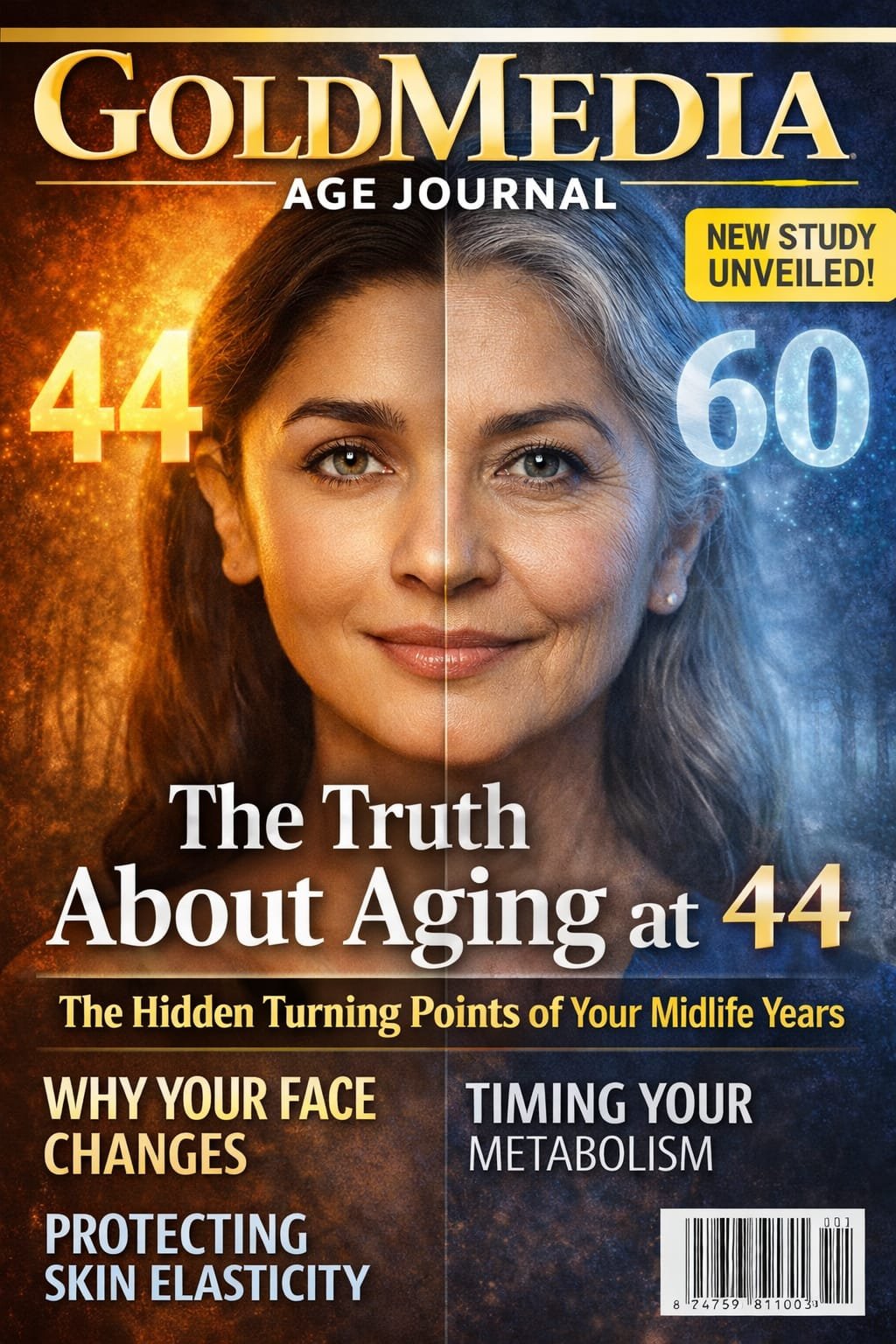
A recent large-scale biological study has challenged one of the biggest myths about aging.
It does not move in a straight line.
It does not slowly decline year after year.
Instead, researchers found that aging accelerates in sharp biological surges — and two ages stand out with striking clarity:
44 and 60.
For anyone between 40 and 49, this isn’t abstract science.
It’s personal.
Because the first surge doesn’t quietly affect your internal organs.
It shows up in your mirror.
The 44 Surge: When Biology Changes Gear
Scientists analyzing thousands of molecular markers — proteins, lipids, inflammatory pathways, metabolic signatures, microbiome patterns — discovered something unsettling:
Around age 44, the body undergoes measurable shifts across multiple systems simultaneously.
This is not symbolic midlife psychology.
It’s molecular recalibration.
And your skin is one of the first organs to reflect it.
Why Your Face Feels “Different” Around 44
You may not notice it at 41.
You may not notice it at 42.
But somewhere between 43 and 45, something changes.
Photographs look slightly harsher.
Under-eye hollowness appears more defined.
Forehead lines stop fading overnight.
The jawline softens.
The skin doesn’t bounce back the way it used to.
This is not vanity.
It’s collagen behavior slowing down.
At 44, shifts in lipid metabolism alter subtle fat distribution in the face. Inflammatory markers rise in small but measurable ways. Cellular turnover declines. Skin repair slows. Elasticity decreases.
Your face becomes the billboard of internal biology.
And for high-functioning professionals in their 40s, this creates a psychological mismatch:
You feel sharp.
But your face begins to signal fatigue.
Why 40 Is Cultural — But 44 Is Chemical
Turning 40 is a social milestone.
Turning 44 is a biological one.
Research shows that around this age:
- Lipid metabolism shifts noticeably
- The body handles alcohol and caffeine differently
- Inflammation patterns alter
- Muscle recovery slows
- Cardiovascular markers begin recalibrating
- Skin cell regeneration declines
These are not dramatic collapses.
They are acceleration points.
And acceleration compounds.
If managed intelligently — through metabolic awareness, muscle preservation, and anti-inflammatory habits — the curve can flatten.
If ignored, the slope steepens quietly.
The Collagen Slowdown No One Warned You About
Collagen doesn’t disappear overnight.
But around 44, its resilience changes.
Fine lines that once softened after sleep remain visible.
Smile lines deepen more quickly.
Skin texture becomes slightly uneven.
The glow that once returned in 24 hours now takes days.
And here’s what makes it more confronting:
This shift often happens while career success peaks.
You are building influence.
But your skin is entering recalibration.
The mirror becomes a reminder that biology does not negotiate with ambition.
The Hidden Metabolic Layer
The facial shift is visible.
But beneath it, deeper changes unfold.
Researchers observed that metabolic pathways — especially those involving fats and lipids — alter around this age. That impacts energy stability, body composition, and even subtle facial fat padding.
At 44:
- Visceral fat becomes harder to control
- Muscle mass requires deliberate effort to maintain
- Blood sugar stability becomes more sensitive
- Sleep recovery becomes more critical
These changes are not catastrophic.
But they are strategic.
The difference between decline and control begins here.
The Psychological Impact of the 44 Shift
There’s a reason many people describe 44–46 as a “quiet wake-up period.”
It’s not crisis.
It’s awareness.
You begin noticing:
“I need more sleep.”
“I don’t recover the same.”
“My face looks slightly older than I feel.”
This is the first aging surge aligning internal biology with external appearance.
And ignoring it doesn’t pause it.
It compounds.
The Second Surge: Age 60
If 44 is visible acceleration…
60 is systemic acceleration.
The same research identified another significant biological shift around 60, affecting:
- Immune function
- Kidney performance
- Cardiovascular resilience
- Muscle retention
- Organ recovery capacity
Wrinkles deepen more aggressively.
Skin thinning becomes pronounced.
Energy dips take longer to reverse.
Immunity becomes more reactive or fragile.
But here is the strategic insight:
Those who stabilized their health during the 44 shift arrive at 60 with far less volatility.
The second wave does not hit equally.
The first surge sets the trajectory.
Why This Research Matters Now
For decades, aging was framed as linear decline.
This new understanding reframes it as phase-based acceleration.
And that changes everything.
If you’re 40–43, you are approaching a checkpoint.
If you’re 44–47, you are inside the shift.
If you’re 48–49, you are seeing its results.
And if you adapt now, the compounding effect toward 60 shifts dramatically.
Strategic Response — Not Panic
This is not a fear narrative.
It is a preparation narrative.
At 44, the smart response includes:
- Prioritizing muscle preservation
- Monitoring metabolic health markers
- Protecting sleep quality
- Reducing inflammatory lifestyle triggers
- Supporting skin health from inside out
Because the body is not collapsing.
It is recalibrating.
And recalibration can be guided.
The Mirror Is Not Your Enemy
It is your early warning system.
When the jawline softens slightly…
When fine lines stay longer…
When under-eye shadows deepen…
It is not failure.
It is biology shifting phase.
Age 44 is not the beginning of decline.
It is the beginning of conscious adaptation.
The Real Takeaway
Aging does not glide forward gently.
It surges.
At 44.
And again at 60.
The first surge changes how you look.
The second surge changes how you recover.
And the space between them is where strategy lives.
The smartest 40–49-year-olds will not deny the shift.
They will respond to it.
Because aging is inevitable.
Acceleration is negotiable.
And awareness is power.


