




























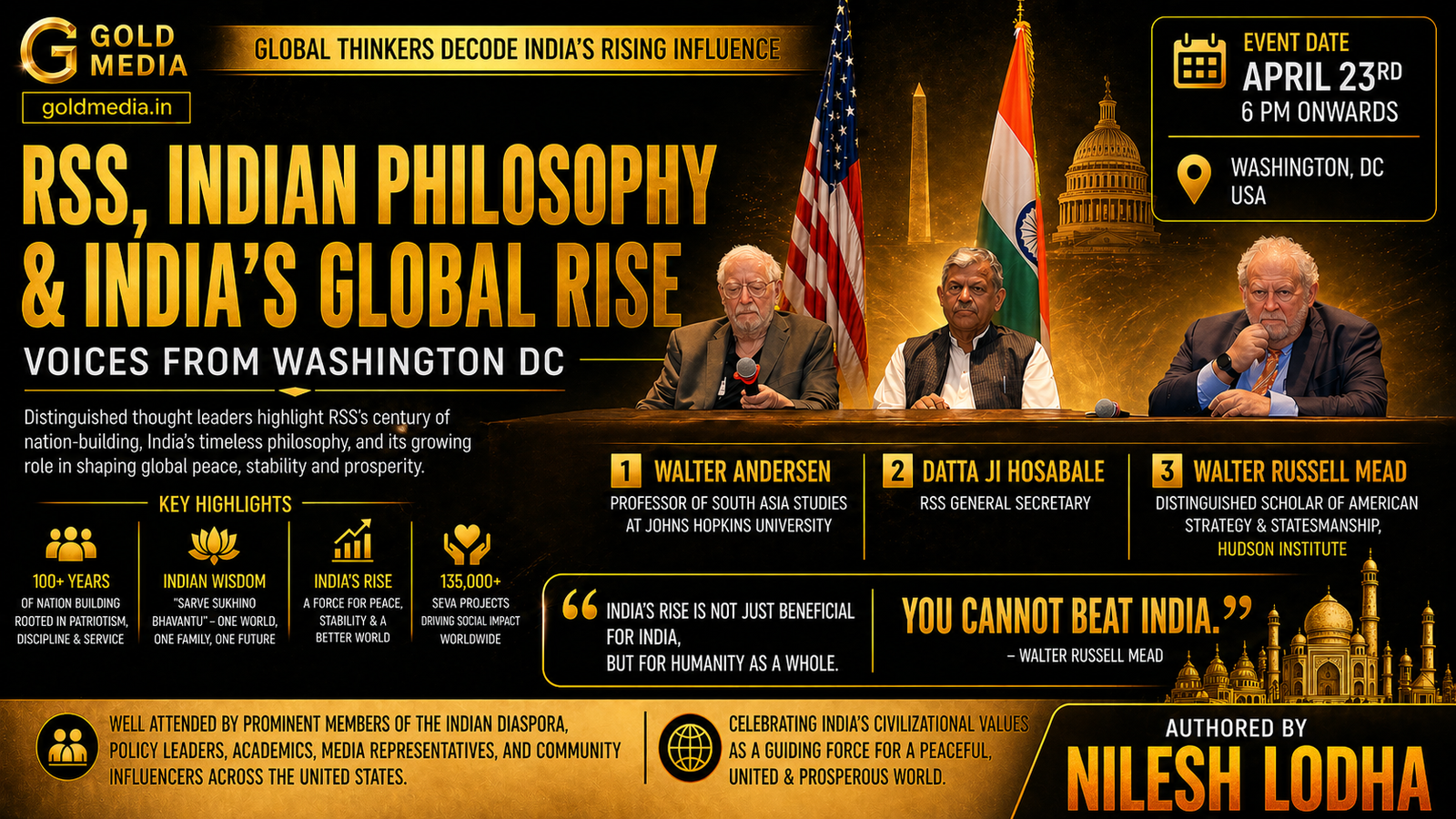
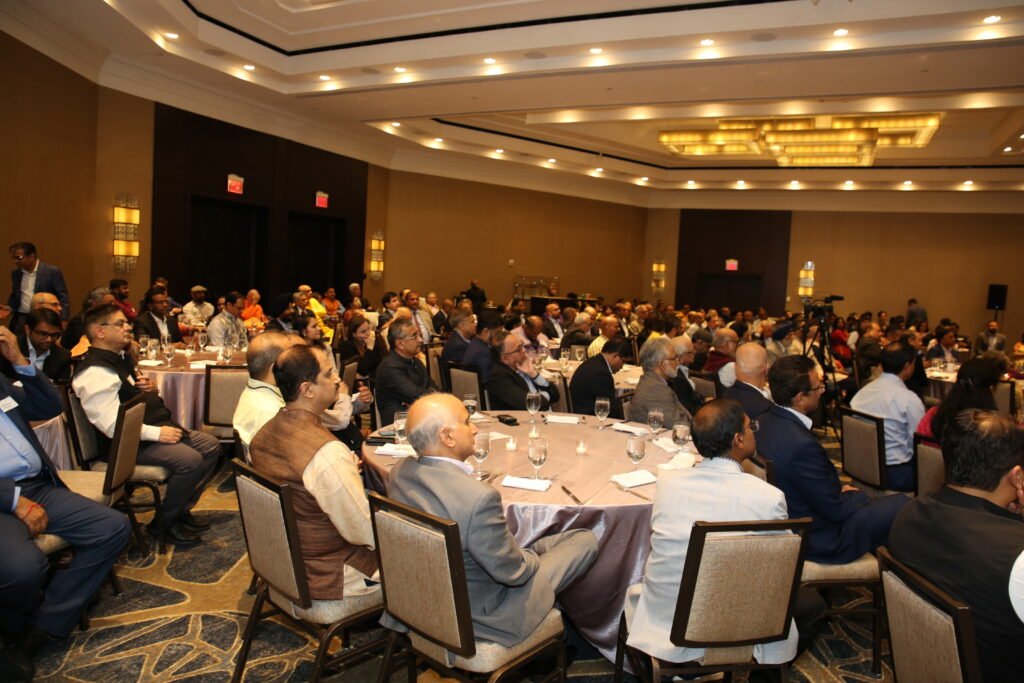
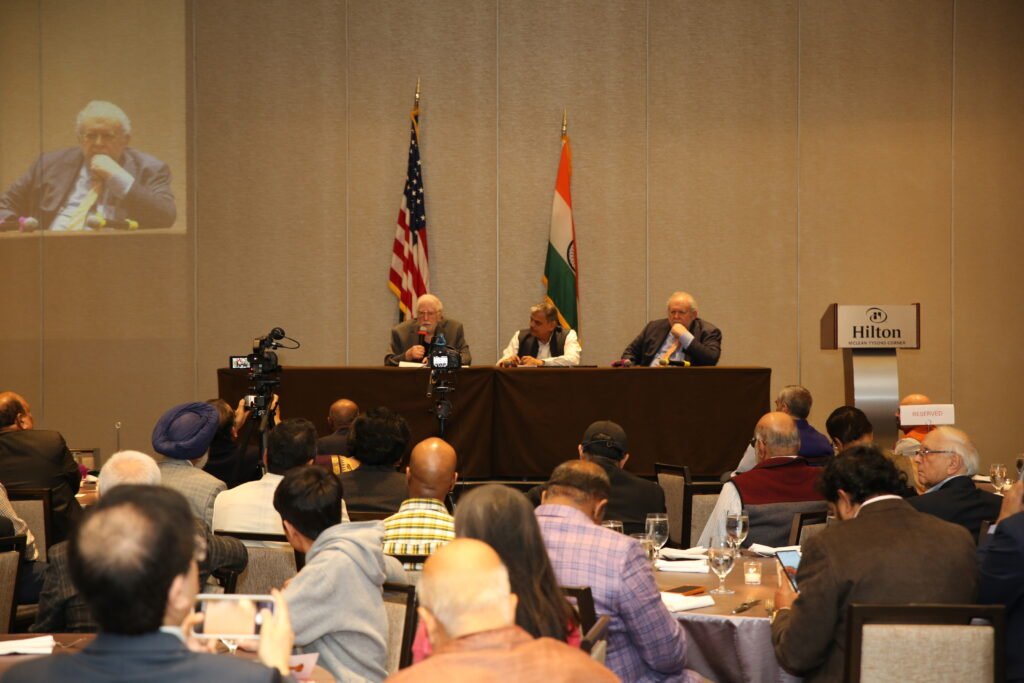
Washington, DC: A distinguished gathering of scholars, policymakers, and community leaders came together in Washington, DC, for a thought-provoking panel discussion on the global impact of the Rashtriya Swayamsevak Sangh (RSS), India’s civilizational values, and India’s growing role in shaping global peace and stability.
The event featured prominent panel guests including Walter Andersen, Professor of South Asia Studies at Johns Hopkins University; Dattatreya Hosabale, widely known as Datta Ji Hosabale and General Secretary of RSS; and Walter Russell Mead, Distinguished Scholar of American Strategy and Statesmanship at Hudson Institute.
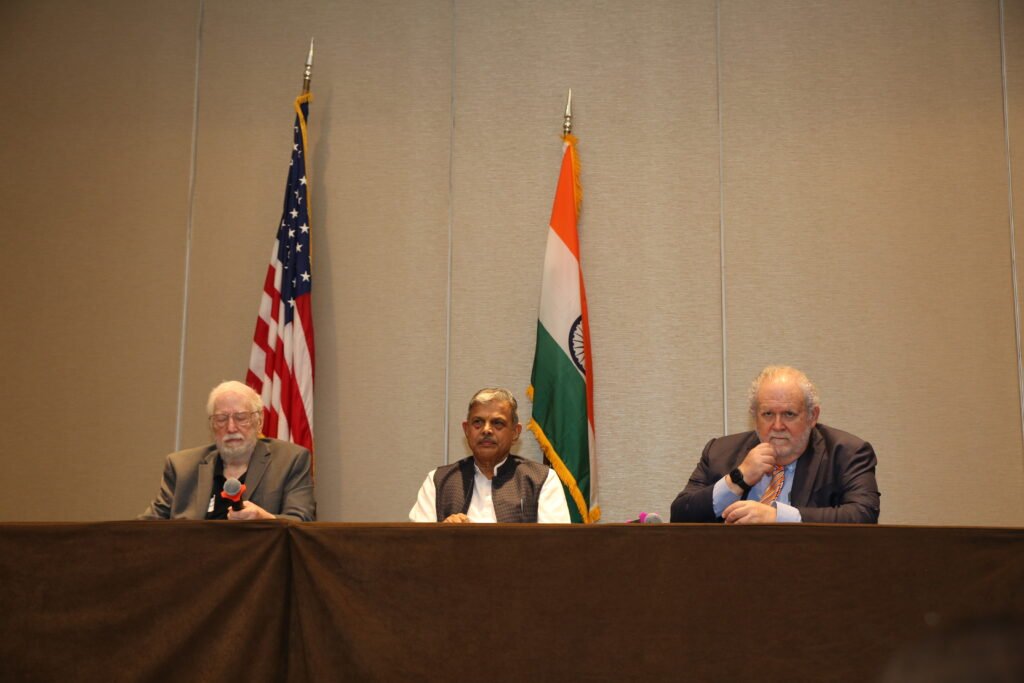
Speaking on the historical and global significance of RSS, Professor Walter Andersen highlighted how the organization has served as a strong pillar of social and national development for over 100 years. Drawing from his extensive research, he explained how RSS has remained deeply committed to its founding principles of patriotism, discipline, service, and loyalty to the nation.
He reminded the audience that RSS was first established in Nagpur in September 1925 and quickly grew into a nationwide movement that contributed significantly during India’s independence era. He emphasized that RSS teaches equality of life and promotes a strong sense of duty toward the nation.
Professor Andersen also pointed to the scale of RSS’s social service impact, noting that more than 135,000 community service projects are currently active worldwide. He further highlighted that RSS manages one of the largest educational ecosystems, with nearly 12,000 schools ranging from elementary to junior college levels. He also referenced that Indian Prime Minister Narendra Modi himself served as an RSS pracharak in his early years.
Addressing the audience, Datta Ji Hosabale shared a powerful message about what India can offer the world during a time marked by rising uncertainty, conflict, and division. He emphasized that Indian philosophy provides timeless guidance for global peace and harmony.
Quoting the Sanskrit phrase “Sarve Sukhino Bhavantu”—meaning “Let everyone be happy”—he spoke about the importance of collective well-being and universal happiness. He reflected on modern society through a moving poem, stating that humanity today spends more but feels less happy, earns more degrees but gains less wisdom, improves in status but loses values, has more food but less nutrition, and lives in increasingly shallow relationships.
He stressed that Indian philosophy teaches that all religions ultimately seek the same truth, though through different paths, and that all beings carry the same divine essence. His message centered on unity, oneness, and coexistence, reinforcing India’s vision of “One World, One Family, One Future.”
Walter Russell Mead spoke on India’s growing strategic importance and its positive influence on global stability, particularly in Asia. He expressed his strong belief that India should emerge as a stronger, more developed, vibrant, and self-confident nation.
He stated that India’s rise is not only beneficial for India itself, but for humanity as a whole. He remarked that India’s diplomatic and strategic approach has significantly reduced the chances of war in Asia and has helped maintain regional peace.
In a strong message directed toward China, Mead asserted that “you cannot beat India,” underscoring India’s resilience and long-term strategic strength.
He further suggested that the United States could learn valuable lessons from India and the RSS model, especially in nurturing values, discipline, and national responsibility among younger generations. According to Mead, adopting some of these philosophies could help America build a stronger future rooted in peace, harmony, and prosperity.
Anderson mentioned, “Rss teaches equality of life”
Data ji mentioned, “India aspires for One world, one family and one future”
Walter mead mentioned, “India can be the path to recovery for America. Wishes peace harmony and prosperity for entire world“
The event concluded with a shared vision of India’s civilizational values serving as a guiding force for a more peaceful and united world, leaving attendees inspired by the powerful message of unity, service, and global harmony.
The event was well attended by prominent members of the Indian diaspora, policy leaders, academics, media representatives, and community influencers from across the United States.