
































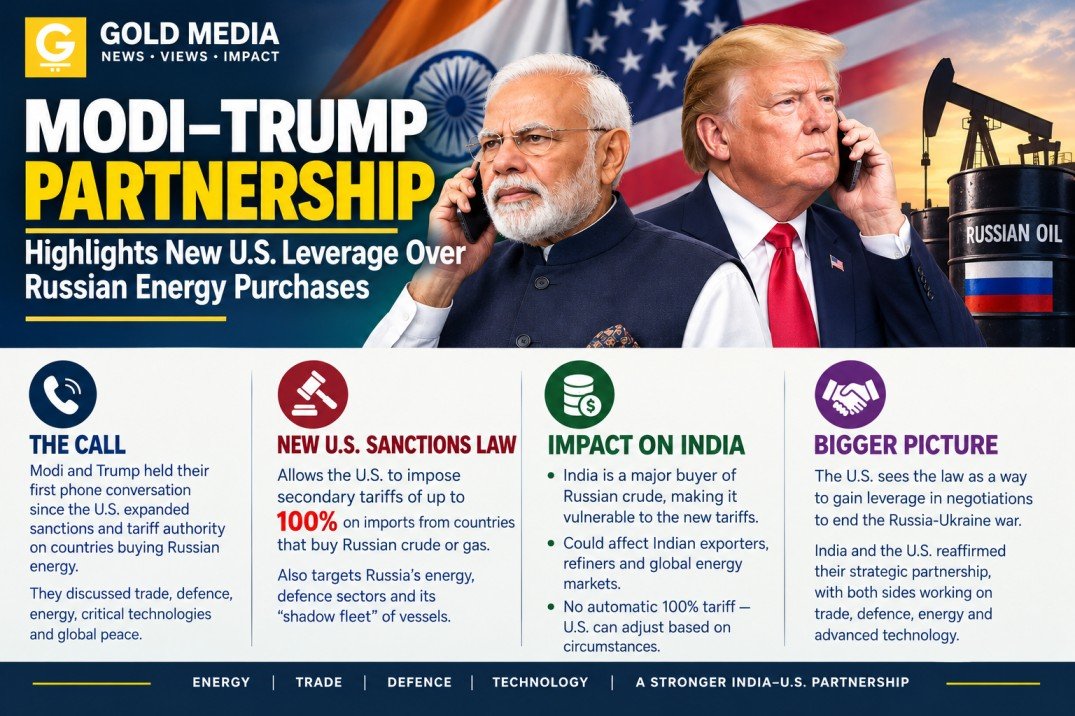
Prime Minister Narendra Modi and President Donald Trump held their first telephone conversation since Trump signed legislation expanding U.S. sanctions and tariff authority over countries that continue purchasing Russian energy. During the call the two leaders discussed trade, defence, energy and critical technologies.
Modi described the September 30 conversation as “productive,” saying the leaders agreed to maintain close engagement as they work to advance the India-U.S. Comprehensive Global Strategic Partnership. According to India’s Prime Minister’s Office, other topics discussed included regional and international developments and ongoing efforts to promote global peace and security.
The call came less than two weeks following Trump’s signing of the Lindsey O. Graham Sanctioning Russia and Iran Act of 2026. The White House said the legislation expands statutory sanctions, tariffs and prohibitions targeting Russia while extending existing sanctions on Iran.
Outlined In The New Russia Sanctions Law
A central provision gives the Trump administration authority to impose secondary tariffs of up to 100% on imports from countries that are major purchasers of Russian crude oil or natural gas. It also imposes tariffs on certain countries identified as facilitating sanctions evasion.
The Congressional Research Service analysis of the legislation says the law directs the president to raise duties to a rate of up to 100% on goods imported from qualifying countries, plus allows the administration to adjust tariff levels depending on changes in each country’s’ Russian energy purchase.
The legislation also targets Russia’s energy and defence sectors including the network of vessels commonly referred to as Russia’s “shadow fleet.” The White House said the law gives the administration additional statutory tools to pressure Russia and increase the costs associated with doing business with Russian.
The Trump administration has presented the measure as part of its broader strategy to create leverage for negotiations aimed at ending the Russia-Ukraine war.
The Potential Impact On India
India is one of the world’s largest buyers of Russian crude and has significantly increased its reliance on discounted Russian oil since the invasion of Ukraine disrupted traditional global energy markets.
That makes New Delhi particularly sensitive to the new U.S. tariff authority. Indian officials have warned that the legislation could affect bilateral relations and global energy markets, but U.S. officials emphasize the need for partners to address energy-security concerns..
Importantly, the legislation does not mean that a 100% tariff is automatically imposed on India. Rather, it gives the president substantial authority to impose and adjust secondary tariffs within the framework established by Congress.
For India, the potential economic impact would extend beyond oil. A tariff on Indian goods entering the United States could affect exporters across sectors, while Indian refiners would also have to weigh the cost and availability of alternative crude supplies.
Trump Administration Seeks Leverage
The administration’s argument is that economic pressure can be used as leverage and allows for presidential flexibility to negotiate.
That approach is significant because the law includes mechanisms that allow the administration to adjust sanctions and tariff measures. The White House has said those authorities are intended to strengthen Trump’s negotiating position and encourage an eventual resolution of the Russia-Ukraine conflict.
The approach also fits into Trump’s broader emphasis on using U.S. economic power in international negotiations. Supporters of the administration’s strategy argue that the United States has greater leverage when access to the American market is connected to foreign-policy objectives.
India-U.S. Relationship And Cooperation
The Modi-Trump conversation underscored the complexity of the relationship between the two countries. Both governments are pursuing cooperation in defense, energy, trade and advanced technology while managing a disagreement over India’s continued Russian crude consumption.
India and the United States nevertheless reaffirmed their commitment to the broader strategic partnership. The Indian government said the two leaders agreed to remain in close contact and deepen cooperation for the benefit of both countries.
The timing is particularly important because Indian Commerce Minister Piyush Goyal is in the United States for trade discussions. Both sides are seeking progress on a broader bilateral trade agreement.
For Trump, the new law provides a congressionally backed instrument to increase pressure on countries that continue purchasing Russian energy while retaining the use of tariffs as part of a wider diplomatic strategy.
For India, the coming weeks will show whether the new tariff authority becomes a major source of friction or leverage for a negotiated arrangement that preserves energy security and protects the broader India-U.S. partnership.