

































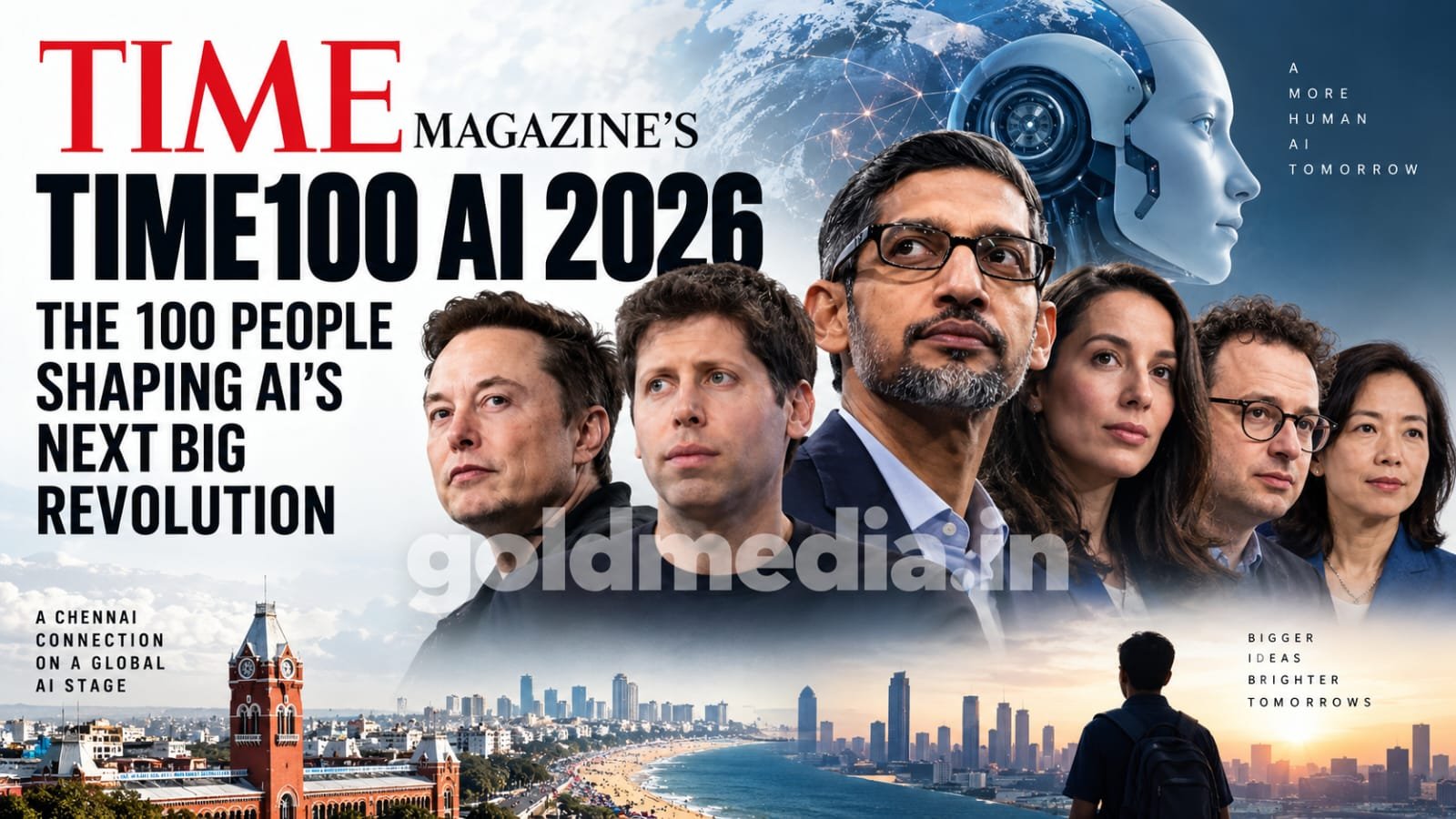
From Sam Altman and Elon Musk to scientists, policymakers and cultural icons — TIME Magazine’s latest AI power list shows just how far artificial intelligence has spread
GOLDMEDIA | TECHNOLOGY
AI HAS LEFT THE CHATBOT ERA.
And TIME Magazine’s TIME100 AI 2026 is a powerful snapshot of what comes next.
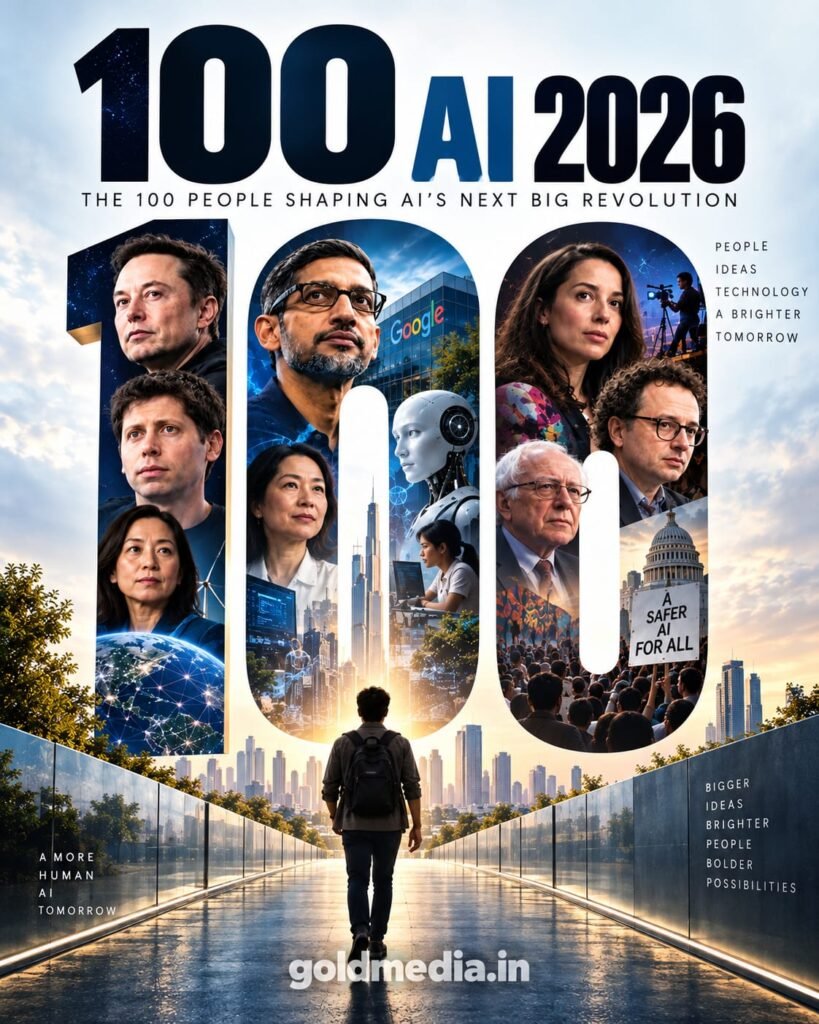
TIME has unveiled its latest TIME100 AI, recognising 100 people whose work, ideas and influence are helping shape the rapidly evolving world of artificial intelligence.
And this year’s list makes one thing crystal clear:
AI IS NO LONGER JUST A SILICON VALLEY STORY.
It is becoming a story about business, science, chips, jobs, government, entertainment, education, creativity and society itself.
GoldMedia brings you the big picture — with full credit to TIME Magazine for the original TIME100 AI 2026 list and reporting.
THE AI POWER LIST IS GETTING BIGGER
The names at the top of the AI revolution will be familiar to anyone following the technology race.
Sam Altman.
Dario Amodei.
Daniela Amodei.
Mira Murati.
Ilya Sutskever.
Fei-Fei Li.
Elon Musk.
But TIME’s selection goes considerably beyond the CEOs and founders building the world’s biggest AI laboratories.
Researchers, infrastructure leaders, policymakers, labour leaders, creatives and people working on the social consequences of AI are also part of the picture.
And that may be the most revealing part of the list.
AI IS NOW EVERYONE’S BUSINESS
A few years ago, an AI power list could have been dominated by computer scientists and technology executives.
Today?
The boundaries have disappeared.
AI is moving into:
SEARCH.
MEDICINE.
FINANCE.
EDUCATION.
MEDIA.
ENTERTAINMENT.
MANUFACTURING.
GOVERNMENT.
DEFENCE.
OFFICE WORK.
CREATIVE INDUSTRIES.
The technology is becoming an underlying layer of the global economy.
That means the people influencing AI are increasingly influencing much more than AI itself.
THE REAL BATTLE MAY NOT BE THE CHATBOT
Chatbots get the headlines.
But behind every powerful AI system sits an enormous technological machine.
Chips.
Data centres.
Cloud computing.
Energy.
Research talent.
Capital.
Data.
The AI race is therefore also becoming a race for infrastructure.
Whoever controls the infrastructure can have enormous influence over how quickly AI develops and how widely it can be deployed.
AND THEN THERE’S THE CHENNAI CONNECTION
For Indians—and particularly for Chennai—the global AI story has an interesting local connection.
Sundar Pichai.
Born and raised in Chennai, the Google and Alphabet CEO has become one of the world’s most influential technology leaders.
Google’s AI transformation places the company at the centre of the race across search, cloud computing, chips and consumer products.
And there is something remarkable about that journey.
A boy growing up in Chennai is now helping lead one of the world’s largest technology companies through what could become the biggest technological transition of his generation.
CHENNAI → SILICON VALLEY → THE AI REVOLUTION.
That is a global technology story with a distinctly Indian beginning.
AI IS NO LONGER JUST FOR TECH NERDS
TIME’s list also reflects another major change.
AI has entered popular culture.
Artists, actors, filmmakers, creators and entertainment figures are experimenting with what generative AI can do.
That raises a completely different set of questions:
Who owns an AI-generated creation?
What happens to traditional creative jobs?
Can AI become a creative collaborator?
And where should the line between human creativity and machine generation be drawn?
The AI debate is therefore moving from engineering departments into Hollywood, newsrooms, classrooms and homes.
WHAT ABOUT JOBS?
This may ultimately be the question ordinary people care about most.
AI can automate certain tasks.
It can also create new capabilities, new jobs and entirely new businesses.
The impact will not necessarily be identical across industries or occupations.
But one trend is becoming increasingly difficult to ignore:
The workplace is changing.
The question for millions of workers may not simply be:
“Will AI take my job?”
It may increasingly become:
“How much of my job will AI change?”
That distinction could become one of the defining questions of the next decade.
THE NEXT AI BATTLE: WHO DECIDES THE RULES?
Technology companies can build increasingly powerful systems.
But governments and societies still have to decide how those systems should be used.
That brings regulation, safety, privacy, copyright, misinformation, labour rights and accountability into the AI conversation.
And this is why TIME’s decision to look beyond technology founders is significant.
The AI future will not be written by engineers alone.
It will be negotiated by society.
100 PEOPLE. ONE HUGE TRANSFORMATION.
TIME100 AI 2026 isn’t simply a list of famous technology personalities.
It is a snapshot of an industry that is rapidly spilling into almost every corner of modern life.
Some are building AI.
Some are researching it.
Some are funding it.
Some are regulating it.
Some are challenging it.
And others are figuring out what happens when humans and machines increasingly work side by side.
THE CHATBOT WAS ONLY THE BEGINNING.
The bigger AI revolution is now moving into the real world.
And TIME Magazine’s TIME100 AI 2026 gives us 100 names to watch as that transformation accelerates.
SOURCE & CREDIT: TIME Magazine — TIME100 AI 2026.
GoldMedia’s article is an independent editorial summary of TIME’s published coverage and does not reproduce TIME’s complete list or ranking.