

































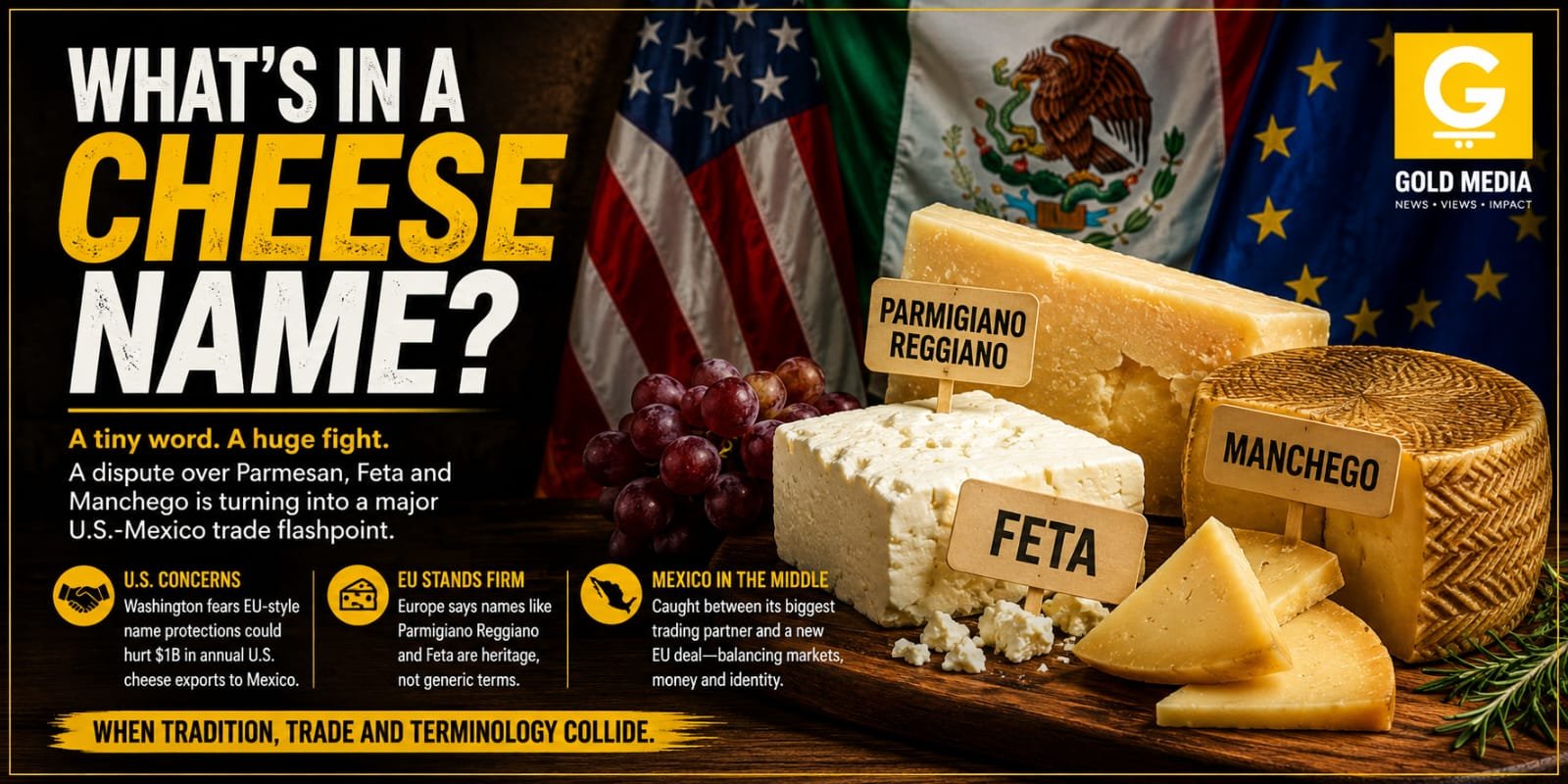
A fight over names like Parmesan, Feta and Manchego has become an unlikely flashpoint in negotiations between Washington and Mexico.
MEXICO CITY/WASHINGTON — It sounds like a dispute that belongs inside a cheesemonger’s shop. Instead, it has landed at the centre of high-stakes trade negotiations.
The United States is pushing Mexico to reconsider protections for the names of hundreds of European food products — including Parmigiano Reggiano, feta and manchego — after Mexico signed a new trade agreement with the European Union.
Washington argues that names such as “parmesan” and “feta” have become generic terms and should remain available to American producers.
The European Union strongly disagrees.
Under the Mexico-EU agreement signed in May, many European regional products would receive greater legal protection in Mexico, potentially preventing producers elsewhere from marketing cheeses using protected names.
And that has turned cheese into a serious trade issue.
WHY WASHINGTON IS PUSHING BACK
For the United States, this is not simply about what appears on a cheese label.
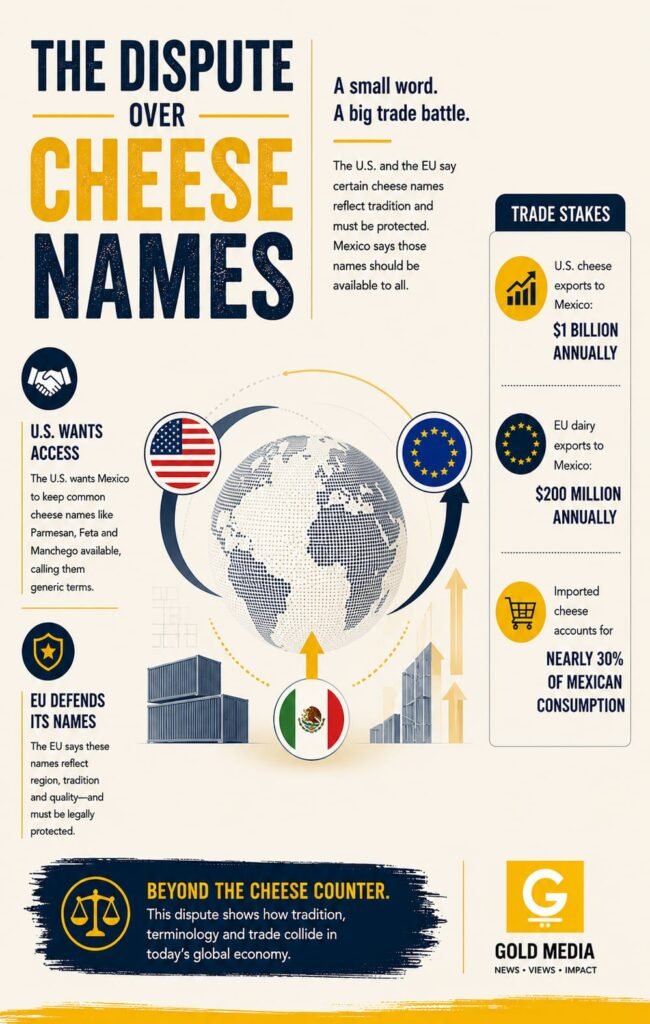
American dairy exporters sell roughly $1 billion worth of cheese to Mexico every year, making Mexico one of the most important overseas markets for U.S. cheese.
American producers fear that stronger European geographical-indication protections could eventually force them to change how some products are marketed in Mexico.
The U.S. dairy industry says Mexico must guarantee that American manufacturers can continue selling products using commonly understood cheese names.
Washington has long criticised the European Union’s geographical-indication system, arguing that restrictions requiring descriptions such as “imitation feta” or “asiago-style” create unnecessary costs and barriers for producers outside Europe.
EUROPE: “THE NAME MATTERS”
For European producers, however, the name is part of the product’s identity.
Parmigiano Reggiano, for example, is associated with a specific region of northern Italy. Feta is linked to particular Greek production traditions. Manchego carries a similar regional identity in Spain.
European producers argue that allowing products made elsewhere to use the same names weakens the value and identity of the original products.
The European Commission has indicated that the terms of the Mexico-EU agreement cannot simply be rewritten because of U.S. objections.
That leaves Mexico caught between two powerful trading partners.
MEXICO’S CHEESE DILEMMA
Mexico has a strong domestic cheese culture of its own.
Oaxaca cheese and queso fresco remain staples of Mexican cuisine, while cheese imports have expanded dramatically over the decades.
Imported cheese now accounts for nearly 30% of Mexican consumption, with the United States supplying the overwhelming share.
U.S. cheese exports to Mexico are worth around $1 billion annually.
European dairy exports, by comparison, are worth roughly $200 million.
That difference explains why Washington has considerable leverage — but it also explains why European producers see Mexico as an increasingly attractive market.
MORE THAN JUST A NAME
Mexican cheesemakers and retailers are divided over the issue.
Some support the Mexico-EU agreement because lower tariffs could make European cheeses more accessible to Mexican consumers.
They argue that European products would largely serve a premium market rather than directly compete with traditional Mexican cheeses.
Others are far more critical of American competition.
Some Mexican cheese producers accuse U.S. exporters of flooding the market with cheaper products, putting pressure on domestic producers.
The debate has therefore become about more than terminology.
It is about price, quality, market access, cultural identity and who gets to control a name.
THE BIGGER TRADE BATTLE
The cheese dispute comes at a particularly sensitive moment.
The United States and Mexico are already engaged in difficult negotiations over an interim trade arrangement, while discussions are also underway surrounding the future of the U.S.-Mexico-Canada Agreement (USMCA).
Mexico has signed the agreement with the EU, but the deal has not yet completed the ratification process required for it to take effect.
That gives Washington an opportunity to press its case.
For Mexico, the challenge is delicate: maintain access to its enormous U.S. market while deepening its relationship with Europe.
For Europe, the issue is about defending a long-standing principle — that certain food names belong to the regions and traditions that created them.
And for the United States, it is about preventing those protections from becoming trade barriers for American producers.
THE BOTTOM LINE
What began as an argument over Parmesan, Feta and Manchego has exposed a much bigger disagreement over how the modern food trade should work.
Should a cheese name describe a product — or protect the place and tradition behind it?
With billions of dollars in trade and much larger negotiations hanging in the balance, the answer may have consequences far beyond the cheese counter.