


































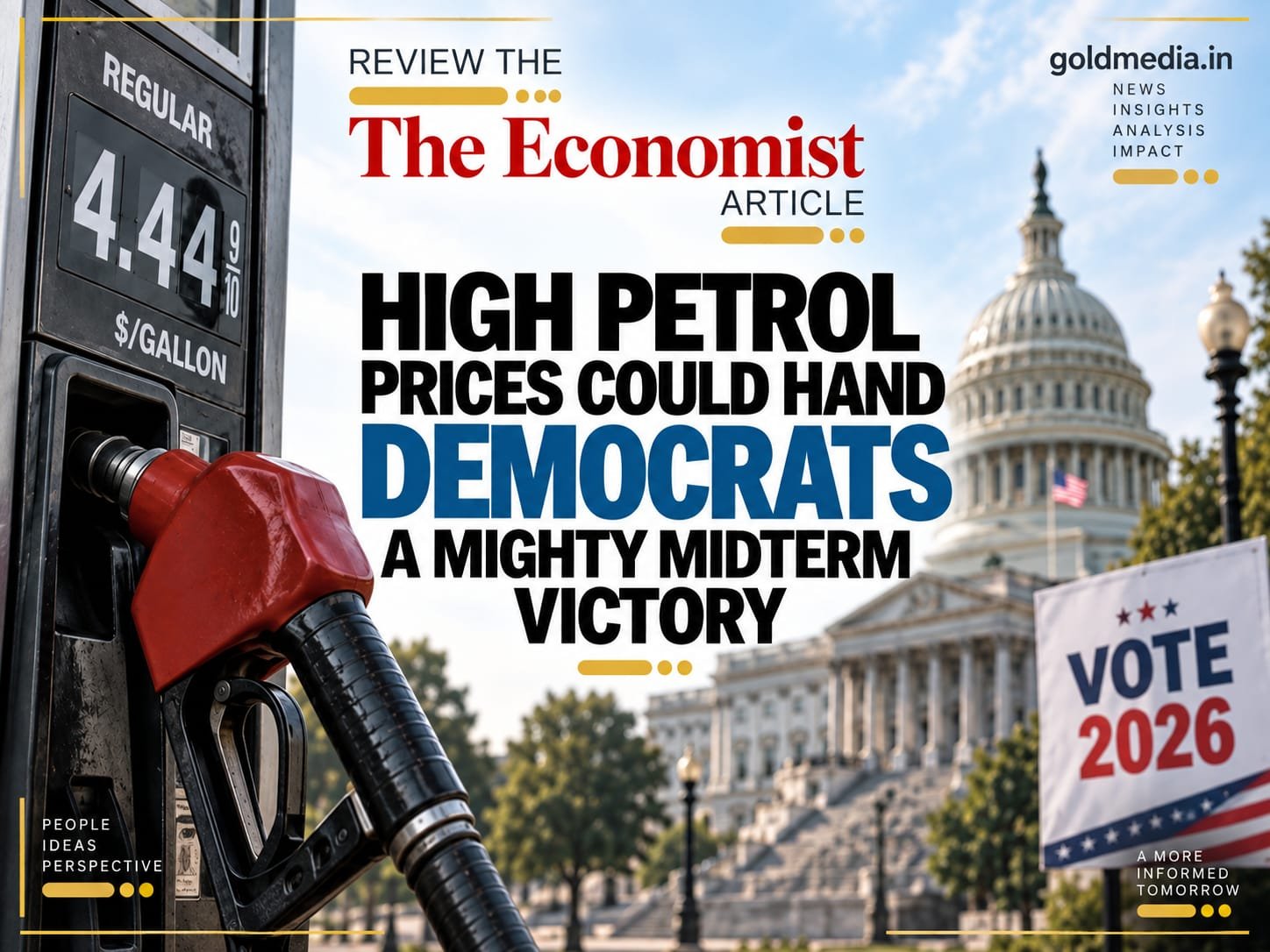
GoldMedia Review of The Economist’s Latest Graphic Detail
18 September 2026 | GoldMedia
A striking political-economic analysis from The Economist is drawing attention to one of the most familiar pressures on American households: the price at the petrol pump.
In its September 17, 2026 Graphic Detail, The Economist examines how elevated petrol prices could influence the 2026 U.S. midterm elections. Its headline makes a bold proposition: “High petrol prices could hand Democrats a mighty midterm victory.”
The publication says its election model gives Democrats a record chance of controlling both the House of Representatives and the Senate.
Why petrol prices matter politically
The underlying idea is straightforward.
When petrol becomes substantially more expensive, the effect is felt immediately by millions of households. Unlike many economic indicators, the price displayed at a petrol station is highly visible and frequently encountered.
Higher fuel costs can also have effects beyond filling a car. Transportation becomes more expensive, increasing costs across parts of the economy, including the movement of goods and potentially food and other consumer products.
That creates a political environment in which an economic shock can become a highly visible issue for voters.
The Economist’s model is the key point
The important distinction is that The Economist is not simply saying that expensive petrol automatically produces a Democratic victory.
Rather, its analysis feeds the petrol-price environment into a broader electoral model.
According to the publication’s September 17 update, the model put the Democrats’ chance of taking control of the House at 93% and the Senate at 59%.
These are model-generated probabilities, not election results and not guarantees of what will happen on November 3.
That distinction matters.
A 93% model probability does not mean that a 2026 Democratic House victory is already determined. It means that, based on the variables and assumptions incorporated into the model at that particular point in time, the model assigns a high probability to that outcome.
The bigger economic story
The petrol-price question also illustrates how geopolitical events can eventually become domestic political issues.
An international disruption affecting oil supplies can move crude prices. Higher crude prices can feed into wholesale fuel prices. Higher fuel prices then reach consumers at the petrol station.
The political consequences, if any, occur much further down that chain.
Geopolitics → oil prices → petrol prices → household costs → economic sentiment → electoral environment
The Economist’s analysis is essentially examining the final part of that chain.
GoldMedia’s takeaway
What makes this Economist analysis particularly interesting is not simply its political conclusion.
It is the attempt to quantify how an economic variable that voters experience in their daily lives can interact with an election model.
Petrol prices therefore become more than an energy-market statistic. They can become a visible measure of economic pressure—and potentially an important variable in an election year.
But there is still a significant amount of time before Americans vote.
Fuel prices can fall or rise. The geopolitical situation can change. Inflation can move. Candidate campaigns can alter the political conversation. And new polling and electoral data will continue to feed forecasting models.
In other words, 93% is a snapshot of a model—not a result from the ballot box.
GoldMedia Review
The value of The Economist’s Graphic Detail is the attempt to connect two subjects that are often analysed separately: the economics of energy prices and the politics of elections.
Whether the relationship ultimately translates into electoral results will only be known after Americans vote.
For now, The Economist is highlighting a simple but powerful political-economic question:
When filling the tank becomes significantly more expensive, how much does that change the way voters see the economy—and the politicians responsible for it?
Source: The Economist, “High petrol prices could hand Democrats a mighty midterm victory,” Graphic Detail, 17 September 2026.
GoldMedia has independently reviewed and contextualised the analysis. The electoral probabilities cited above are attributed to The Economist’s model and should not be interpreted as GoldMedia forecasts.