


































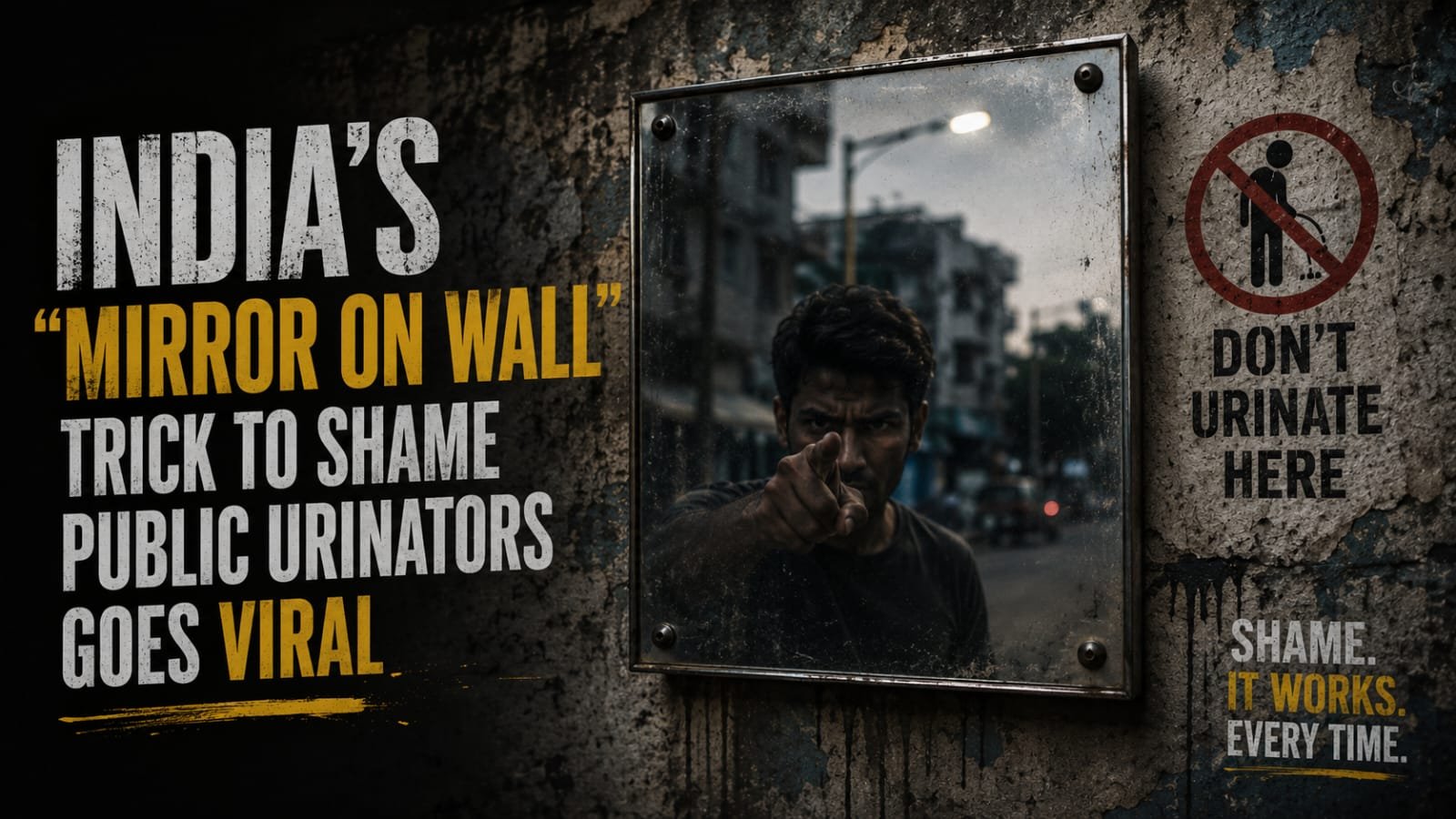
One mirror. One wall. Zero police. Suddenly public urination stops.
In a country where ₹100 crore awareness campaigns, giant fines, “Swachh Bharat” slogans, and endless warnings often fail…
a simple mirror pasted on a wall in Mysuru is now being called “genius-level governance.”
And honestly?
The internet may not be wrong.
The Viral “Shame Psychology” Trick
Authorities in Mysuru reportedly installed large mirrors on walls that people frequently used as public urinals.
Result?
People stopped peeing there.
Why?
Because nobody likes watching themselves commit an embarrassing act in real-time.
The mirror creates instant self-awareness, discomfort, and social shame — without a single cop standing nearby.
No technology.
No AI.
No CCTV.
No lecture.
Just human psychology.
And the internet exploded.
Social Media Is Calling It “Nobel Prize Level Innovation”
Comments ranged from:
- “This is smarter than most smart-city projects.”
- “India doesn’t need AI, it needs mirrors.”
- “Peak Indian jugaad.”
- “A ₹500 solution to a ₹50 crore problem.”
The reason this story hit so hard is because people instantly recognized something uncomfortable:
The solution worked because people fear embarrassment more than punishment.
That says a lot about society.

But The Bigger Question Nobody Is Asking…
Why are Indian cities still fighting public urination in 2026?
That’s the real story.
Because beneath the funny viral post lies a much darker urban reality:
- Poor public toilet access
- Bad maintenance
- Broken civic habits
- Weak enforcement
- And normalization of public filth
The mirror didn’t solve sanitation.
It solved visibility.
And maybe that’s the most Indian thing ever.
The Real Genius Here? Behavioral Design.
Globally, cities increasingly use behavioral psychology instead of brute-force policing.
Examples include:
- Fly stickers inside urinals to improve aim
- Piano staircases encouraging fitness
- Fake speed cameras slowing traffic
- Red footprints guiding crowd movement
Mysuru’s mirror trick belongs to that category:
cheap, psychological, and brutally effective.
Sometimes governance is not about force.
It’s about understanding human ego.
India’s Urban Problem: We Build Infrastructure… But Ignore Behaviour
India often focuses on:
- building roads,
- launching campaigns,
- printing slogans,
- announcing missions.
But civic behavior change is much harder.
And perhaps that’s why this tiny mirror became national news.
Because deep down, Indians know:
this small idea achieved what massive campaigns often fail to do.
Goldmedia Take
The mirror isn’t viral because it’s funny.
It’s viral because it exposes a truth:
- India’s biggest civic challenge is not infrastructure alone.
- It is public behavior.
- And sometimes, psychology beats policy.
One mirror on one wall just reminded the country of that.