


































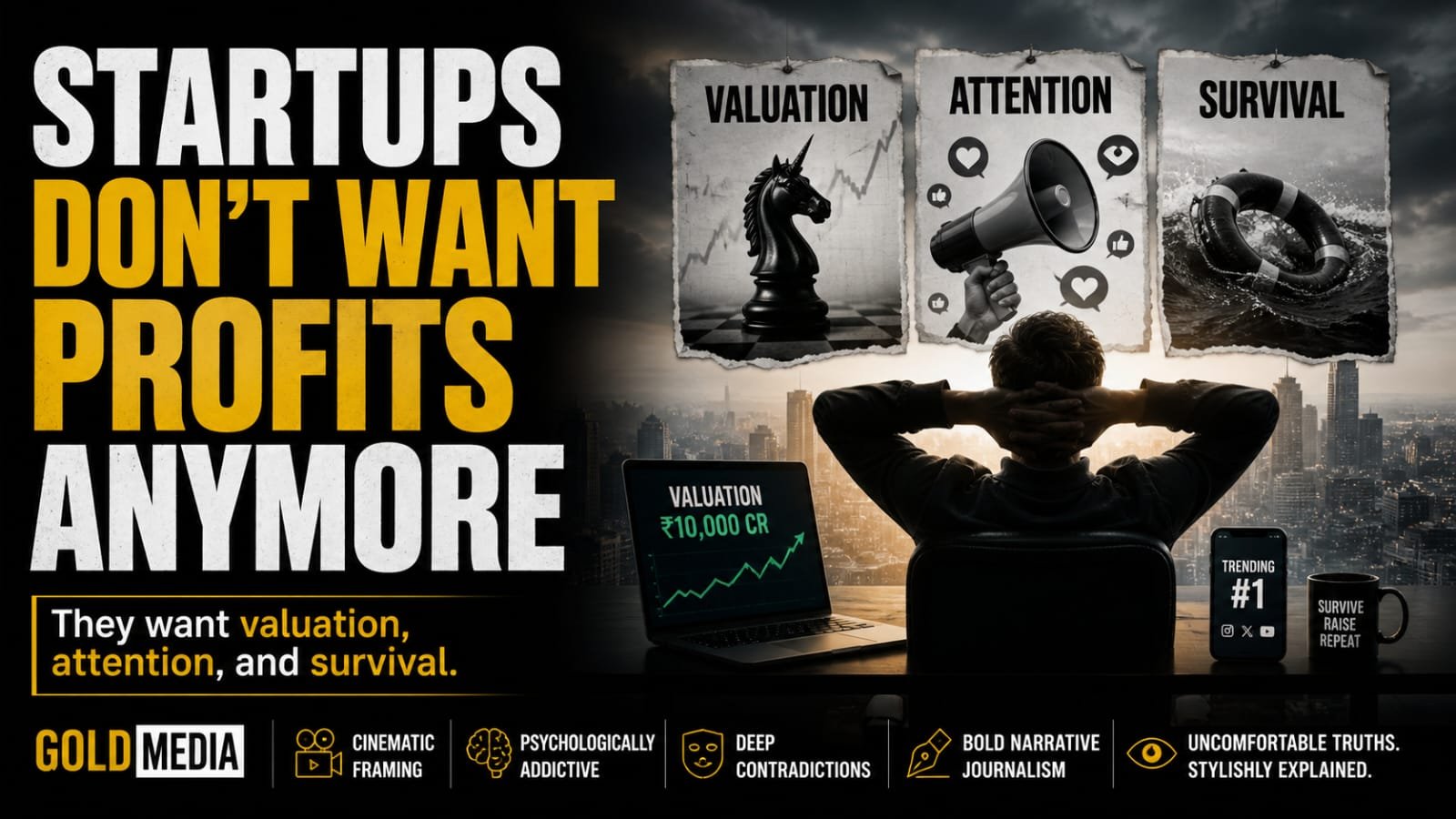
They want valuation, virality, and one more funding round.
For decades, business was brutally simple.
A company made something useful, sold it for more than it cost to produce, generated profit, survived, expanded, and eventually became an institution.
Profit was not just a metric.
It was proof that reality agreed with your business model.
But somewhere between venture capital euphoria, social media virality, and the global obsession with “disruption,” the startup world quietly rewrote that ancient rulebook.
Today, a company can lose hundreds of crores, fire employees, burn investor money at industrial scale, and still be described as “promising.”
In fact, in modern startup culture, profitability can sometimes look… suspiciously unambitious.
Because startups are no longer competing merely to build businesses.
They are competing to dominate attention.
A founder announces layoffs on LinkedIn and trends for two days.
Another startup loses money on every order but celebrates “record user growth.”
A food delivery app spends crores on celebrity marketing while struggling to generate sustainable margins.
Yet investors continue funding them, podcasts continue glorifying them, and media headlines continue calling them “future unicorns.”
Why?
Because the startup economy discovered a dangerous and fascinating truth:
“Attention can temporarily replace economics.”
That single realization changed everything.
The modern startup ecosystem is not built entirely on profits anymore.
It runs on something far more emotional:
belief.
- Investors fund belief.
- Media amplifies belief.
- Users participate in belief.
- Founders perform belief.
And valuation becomes the scoreboard of that collective optimism.
This is why some startups today behave less like traditional companies and more like cinematic universes constantly trying to secure their next sequel.
- Every funding round becomes a trailer.
- Every expansion announcement becomes marketing theatre.
- Every viral interview becomes investor signaling.
The actual business model?
That part can come later.
Or at least, that is the hope.
In the old economy, losing money consistently was considered failure.
In the new startup economy, losing money aggressively can actually signal ambition.
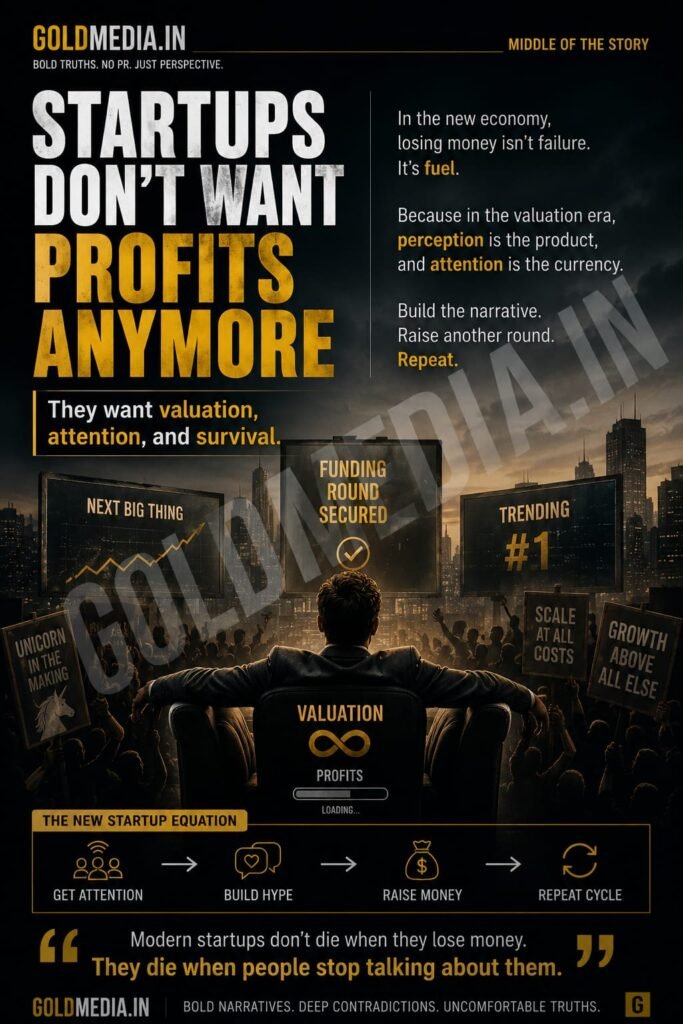
Because massive losses often communicate something psychologically powerful to investors:
speed.
It tells the market:
“We are expanding so fast that profitability would only slow us down.”
And sometimes, that logic genuinely works.
Many transformative companies did spend years prioritizing scale before profits.
That part is true.
But the problem begins when the ecosystem starts rewarding spectacle more than sustainability.
A profitable traditional business employing 500 people quietly will rarely make headlines.
A cash-burning startup delivering groceries in 10 minutes while losing money on every transaction?
That becomes a national conversation.
Because modern media incentives reward excitement, not stability.
And startups learned to adapt accordingly.
The result is a strange new economic culture where perception itself has become an asset class.
Founders are no longer judged only by balance sheets.
They are judged by visibility.
Can they trend?
Can they attract attention?
Can they create FOMO among investors?
Can they sound visionary enough to delay uncomfortable financial questions for one more quarter?
Because in the valuation era, survival itself became performance art.
✍️ Authored by Nilesh Lodha — Goldmedia.in | Bold Truths. No PR. Just Perspective
(All ideation, concept, headlines, sub-headings, punchlines and section-wise structuring by the author; editorial refinement and language styling by the Goldmedia.in Editorial Team.)
06 May 26, 15:05 IST