



































Why borrowing to invest in American residential property is becoming increasingly difficult to justify
For decades, American real estate has been sold as one of the safest wealth-building strategies:
Buy a property. Take a mortgage. Let the tenant pay the mortgage. Wait for the property to appreciate.
It sounds almost foolproof.
But the mathematics of U.S. residential real estate have changed dramatically.
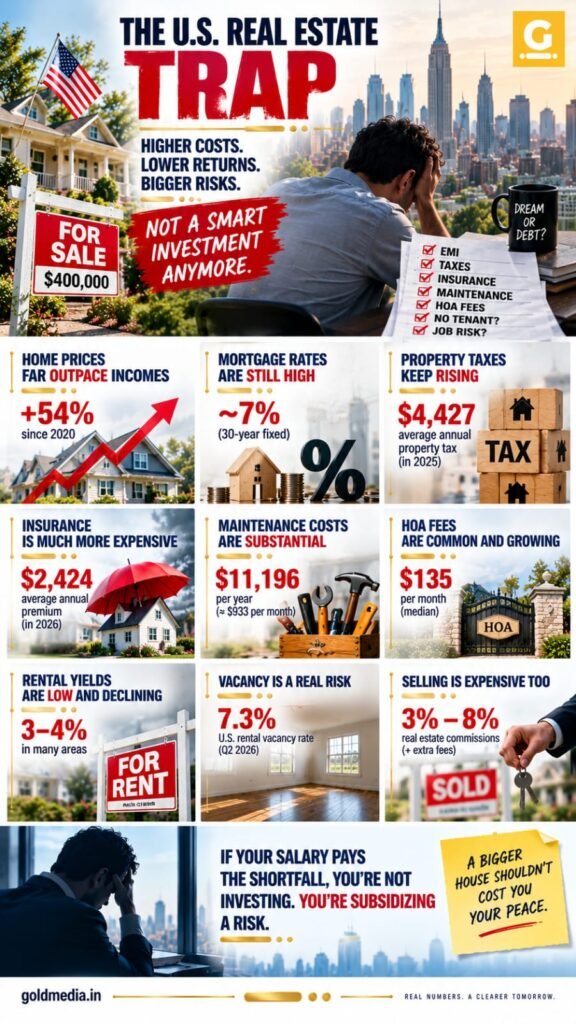
Home prices remain elevated. Mortgage rates are near 7%. Property taxes continue to rise. Insurance has become increasingly expensive in many markets. Maintenance is not cheap. HOA fees are becoming more common. Rental yields are under pressure in many counties. Selling a property also costs money.
And when the property is purchased with a loan, there is another risk that receives far too little attention:
The property may not actually be paying for itself. The investor’s salary may be.
That distinction can turn a supposedly passive investment into a long-term financial burden.
The argument here is not that every U.S. property is a bad investment. Exceptional properties, unusually high-yield markets, distressed purchases and all-cash investments can still make sense.
The argument is much more specific:
For a salaried individual who must borrow heavily and depend on monthly employment income to cover the property’s shortfall, today’s U.S. residential real-estate economics can be extraordinarily unforgiving.
1. The mortgage is only the beginning
The first mistake investors make is looking at the mortgage payment and asking:
“Can I afford the EMI?”
That is the wrong question.
The correct question is:
“What is the total economic cost of owning this property?”
That includes:
- mortgage interest
- principal repayment
- property taxes
- homeowners insurance
- maintenance
- repairs
- capital expenditure
- HOA or condominium fees
- utilities paid by the owner
- vacancy
- property management
- leasing costs
- legal and accounting costs
- transaction costs when buying
- transaction costs when selling
- taxes on investment income and gains
- currency risk for foreign investors
The mortgage is merely the most visible line item.
And the invisible line items are getting increasingly expensive.
The U.S. Census Bureau reported that median monthly owner costs for homeowners with a mortgage reached $2,035 in 2024, up 26% from 2019. Those costs include mortgage payments, taxes, insurance, utilities and various fees.
That is the reality of ownership.
The house does not come with just a mortgage.
2. Borrowing money now costs dramatically more
As of September 17, 2026, the average U.S. 30-year fixed mortgage rate had reached 6.95%, its highest level since January 2025, according to Freddie Mac data reported by Reuters.
Compare that with the extraordinary 2020–21 era, when 30-year mortgage rates fell below 3%.
That difference completely changes the investment mathematics.
Consider a hypothetical investor buying a:
$400,000 property
with:
20% down payment = $80,000
and:
$320,000 mortgage
At approximately 6.95%, the first year’s interest alone is roughly:
$22,240
That is approximately $1,853 every month in interest alone.
And interest is only one component of the mortgage payment.
Now add taxes.
Insurance.
Maintenance.
Vacancy.
Management.
HOA.
Suddenly, the supposedly “self-paying” investment looks very different.
3. Home prices have outrun household incomes
Harvard University’s 2026 State of the Nation’s Housing report describes a market where housing affordability remains severely constrained.
The median existing single-family home was approximately $409,000 at the end of 2025.
Under Harvard’s assumptions, the mortgage payment alone was approximately $2,420 per month.
Once mortgage insurance, property insurance and property taxes are incorporated, the total monthly cost of owning the median-priced home reached approximately:
$3,120 per month
at the end of 2025.
Even more revealing, Harvard estimated that a household needed approximately $120,800 of annual income to afford the median-priced home at a typical 31% debt-to-income ratio.
Five years earlier, the required income was only approximately $68,700.
That is not a minor deterioration.
It means the income required to carry the median home has risen dramatically.
For a salaried investor, that matters twice:
The investor has to earn enough to support his own life—and enough to subsidize the investment property if the property cannot support itself.
4. Property taxes never retire
One of the most overlooked facts about American real estate is that paying off the mortgage does not eliminate the cost of owning the property.
Property taxes continue.
ATTOM reported approximately $396.8 billion in property taxes levied on more than 89.6 million single-family homes in 2025.
The average single-family property-tax bill reached approximately:
$4,427 per year
and increased about 3% from the previous year.
That is roughly $369 every month before considering anything else.
And national averages can conceal enormous differences.
Some states have effective property-tax rates well above the national average.
For an investor, property tax is particularly important because it is not linked to whether the property produces rent that month.
Tenant or no tenant, the tax bill arrives.
Mortgage or no mortgage, the tax bill arrives.
Job or no job, the tax bill arrives.
5. Insurance is becoming a structural problem
Insurance is another cost that investors often underestimate.
The U.S. Government Accountability Office reported in 2026 that homeowners insurance premiums increased nationally between 2019 and 2024, with increases of 25% or more in southern coastal areas. Insurance affordability and availability have deteriorated particularly in areas exposed to natural disasters.
This creates an uncomfortable situation for leveraged investors.
The mortgage lender generally requires insurance.
Therefore, an investor cannot simply respond to an insurance increase by saying:
“I don’t want to pay it.”
The cost must be absorbed.
And in high-risk markets, insurance can become a major part of the property’s annual carrying cost.
6. Maintenance can destroy the illusion of rental profitability
A property does not remain new forever.
Roofs deteriorate.
HVAC systems fail.
Water heaters fail.
Plumbing fails.
Appliances fail.
Exterior surfaces need work.
Landscaping requires maintenance.
Electrical systems age.
Eventually, major components need replacement.
Bankrate’s 2025 analysis estimated average annual hidden homeownership costs of approximately $21,400 per year, excluding the mortgage. Its estimate included property taxes, insurance, utilities, internet/cable and maintenance.
The maintenance component alone was estimated at approximately $8,808 annually.
That is roughly:
$734 per month
before the mortgage.
And these are averages.
A single major repair can easily exceed an entire year’s maintenance budget.
7. HOA fees are becoming another permanent monthly bill
The American homeowner increasingly has another expense: the homeowners association.
Realtor.com found that 43.6% of U.S. homes listed for sale in 2025 carried a non-zero HOA fee, compared with only 34.3% in 2019.
The median HOA fee reached $135 per month, up from $108 in 2019.
And some markets are dramatically more expensive.
In Miami-Fort Lauderdale-West Palm Beach, Realtor.com found a median HOA fee of approximately $617 per month among qualifying listings—equivalent to 26.9% of the monthly mortgage payment used in its analysis.
For an investor, this is important:
HOA dues are not mortgage principal.
They do not create equity.
They are simply a recurring cost of holding the property.
8. Rental yield is the number investors should fear
Here is where the investment argument becomes particularly uncomfortable.
ATTOM’s 2026 Single-Family Rental Market Report found that potential rental yields declined in 54.8% of the U.S. counties it analyzed.
In other words, in more than half of the counties studied, the relationship between property prices and potential rental income deteriorated.
And some markets have extremely low gross yields.
That creates a basic mathematical problem.
Suppose a property produces:
4% gross rental yield
while the investor is paying approximately:
7% mortgage interest
The investor is already facing a negative spread before accounting for:
- property tax
- insurance
- maintenance
- vacancy
- management
- HOA
- repairs
- legal costs
That is not a minor issue.
It means the investment may depend heavily on future appreciation to compensate for weak current economics.
In other words:
The investor is borrowing money today to bet that the property will become more valuable tomorrow.
That is leverage—not guaranteed wealth creation.
9. Gross rent is not investment return
This distinction needs to be hammered home.
Suppose a $400,000 property generates a 4.5% gross rental yield.
Annual rent:
$18,000
It sounds attractive.
But now subtract realistic costs.
Illustratively:
Gross rent: +$18,000
Property tax: −$4,427
Insurance: −$2,424
Maintenance: −$8,808
Mortgage interest: −$22,240
The result is approximately:
−$19,899
And this is before vacancy, management, HOA fees, major capital repairs, legal/accounting costs and selling costs.
This is not a prediction for every property.
It is an illustration of why investors must never confuse:
Gross rental yield
with
Net investment return.
A property can have a positive rental yield and still be a negative-cash-flow investment.
10. Vacancy does not stop the mortgage
The Census Bureau reported a U.S. rental vacancy rate of approximately 7.3% in Q2 2026.
That does not mean every investment property will be vacant 7.3% of the year.
But it demonstrates that vacancy is an ordinary feature of the rental market—not an impossible scenario.
One vacant month removes approximately:
8.3% of annual rental income.
Two vacant months remove approximately:
16.7%.
But the following expenses continue:
Mortgage.
Property tax.
Insurance.
HOA.
Utilities.
The tenant stops paying.
The bills do not.
11. And then there is the cost of selling
Investors often calculate appreciation without calculating the cost of realizing that appreciation.
That is a serious mistake.
Selling a property involves commissions and other transaction expenses.
Freddie Mac notes that real-estate commissions can typically range from 3% to 8% of the sale price, with additional costs potentially adding another 2% to 4%, depending on the transaction.
Therefore:
A property rising 10% does not necessarily produce a 10% investment return.
The investor has to pay to enter.
Pay to hold.
Pay taxes and operating expenses while holding.
And potentially pay substantial costs to exit.
12. Leverage makes the situation much more dangerous
Consider the same $400,000 property.
Investor’s own money:
$80,000
Bank’s money:
$320,000
Now suppose the property rises 10%.
Property value becomes:
$440,000
Gross increase:
$40,000
Relative to the investor’s original $80,000 equity, that looks like a spectacular 50% return on equity—before costs.
This is why leverage is seductive.
But leverage works in both directions.
If the property falls 10%:
$400,000 → $360,000
The investor loses:
$40,000
That is half of the original $80,000 equity.
A 10% decline in the property has therefore produced a:
50% decline in the investor’s original equity
before transaction costs.
The bank’s loan did not fall by 10%.
The investor’s equity absorbed the loss.
Leverage magnifies the outcome. It does not magically create wealth.
13. The salaried investor has the biggest vulnerability
This is the most important part of the argument.
A wealthy investor with substantial liquid assets can deliberately carry a property that loses money every month.
A salaried middle-class investor is in a very different position.
Imagine:
Salary: $8,000/month
Investment-property shortfall: $1,500/month
The investor is effectively using nearly:
19% of salary
to subsidize the property.
That is:
$18,000 every year.
Over five years:
$90,000
of additional cash contributions.
And that assumes the shortfall remains constant.
What happens if:
- the tenant leaves?
- the roof needs replacement?
- insurance rises?
- property tax rises?
- HOA dues increase?
- the HVAC fails?
- the property sits vacant for three months?
- the investor loses his job?
The mortgage does not care.
The bank still wants its payment.
14. This creates a dangerous financial chain
The structure becomes:
Salary → mortgage → property → hoped-for appreciation
rather than:
Property → rent → expenses → surplus cash flow → investor
The second structure is what investors generally want.
The first structure means the investor is using employment income to support an investment whose future return is uncertain.
That is a fundamentally fragile arrangement.
A salary is dependent on employment.
A mortgage is a contractual obligation.
A property is illiquid.
And the investor’s wealth becomes concentrated in one physical asset in one location.
Put all three together and the risk becomes obvious.
15. Employment risk and property risk can arrive together
This is particularly important for salaried investors.
Imagine an economic downturn.
The investor loses employment.
At exactly the same time:
- property prices weaken
- tenants become harder to find
- rents stagnate
- vacancy increases
- refinancing becomes difficult
The investor needs cash precisely when the property is hardest to sell.
And because real estate is illiquid, the investor cannot necessarily sell tomorrow at a price he wants.
That is the danger of leverage.
Debt does not wait for the market to recover.
16. “The property will appreciate” is not enough
The strongest argument in favor of U.S. real estate is simple:
American property has historically appreciated over long periods.
That is true.
But historical appreciation does not guarantee the return on a particular property purchased at today’s price.
Harvard’s 2026 housing report says existing-home sales have remained near a three-decade low since 2023, while housing demand has weakened and household growth has slowed.
ATTOM also reported that homes remained less affordable than their historical norms in 97% of analyzed counties in Q1 2026.
This does not prove that U.S. property prices will fall.
It demonstrates something more important for an investor:
You cannot safely build a leveraged investment strategy on the assumption that strong appreciation will rescue weak cash flow.
17. Foreign investors face another layer of complexity
For an investor outside the United States, the calculation becomes even more complicated.
There may be:
- U.S. federal taxation
- state taxation
- property taxes
- insurance
- property management
- currency fluctuations
- banking costs
- tax compliance
- withholding requirements
- cross-border reporting
- selling costs
The IRS also imposes specific rules on nonresident aliens receiving U.S. real-property income, while FIRPTA generally requires withholding when a foreign person disposes of U.S. real property.
Therefore, a foreign investor cannot simply calculate:
Rent − mortgage = profit.
The tax and compliance structure matters.
18. The opportunity cost is enormous
There is one more question that property investors should ask:
What else could my down payment and monthly cash contribution do?
Suppose an investor puts:
$80,000 down
and then spends another:
$1,000 per month
supporting the property.
That is not merely a real-estate investment.
It is also an opportunity-cost decision.
The same capital could potentially be allocated across:
- diversified equities
- bonds
- money-market instruments
- retirement accounts
- businesses
- other assets
- debt reduction
- emergency reserves
Those alternatives have different risks and returns, of course.
But the point is simple:
Real estate does not compete only against other properties.
It competes against every other productive use of your capital.
19. The real test is brutally simple
Before buying an investment property with debt, calculate:
Annual rent
minus:
vacancy
minus:
property management
minus:
property tax
minus:
insurance
minus:
maintenance
minus:
capital expenditure
minus:
HOA
minus:
utilities
minus:
mortgage interest
minus:
other expenses
equals:
NET CASH FLOW
Then ask:
Does the property generate a meaningful surplus?
If the answer is no, the investor is relying on something else.
Usually:
future appreciation.
That is where the investment becomes speculative.
20. The salary test
For a salaried investor, there should be one additional test:
“If this property produces zero rent for six months, can I comfortably carry it without changing my lifestyle or touching emergency savings?”
If the answer is no, the investment is highly dependent on continuous employment income.
Ask another question:
“If the property falls 15% and remains there for five years, can I still comfortably hold it?”
If the answer is no, leverage may be too high.
And finally:
“If I never receive spectacular appreciation, does the rental income still make the investment worthwhile?”
If the answer is no, the investment thesis is largely an appreciation bet.
THE BOTTOM LINE
The American dream of property ownership and the economics of property investment are not the same thing.
A person buying a home to live in may receive benefits that cannot be measured purely in rental yield.
But buying an investment property with borrowed money is different.
Today’s environment combines:
high property prices
6.95% mortgage rates
rising insurance costs
property taxes
maintenance
HOA fees
vacancy risk
management costs
selling costs
tax complexity
weak or declining rental yields in many markets.
The result is a property that can look attractive on a real-estate agent’s brochure while producing poor economics on an investor’s spreadsheet.
The most dangerous sentence in leveraged real estate is:
“Don’t worry—the property will appreciate.”
Maybe it will.
But the mortgage payment is due now.
The property tax is due now.
The insurance premium is due now.
The maintenance bill is due now.
The HOA fee is due now.
The investor’s salary is doing the work now.
The appreciation is only a possibility.
That is the fundamental problem with borrowing heavily to buy an investment property.
You are certain about the debt.
You are uncertain about the return.
For a salaried investor with limited surplus cash, that asymmetry deserves serious attention.
If the property cannot comfortably service its own realistic carrying costs, the investor is not truly buying a self-sustaining income-producing asset.
He is using his salary to subsidize a leveraged, illiquid asset while hoping that future appreciation will make the mathematics work.
That can work.
But it is not the low-risk, self-paying investment that the traditional real-estate story often makes it sound like.
Before borrowing to buy U.S. real estate, don’t ask:
“Can I afford the mortgage?”
Ask:
“Can the property afford itself?”
If the answer is no, the most important asset financing the investment may not be the property.