


































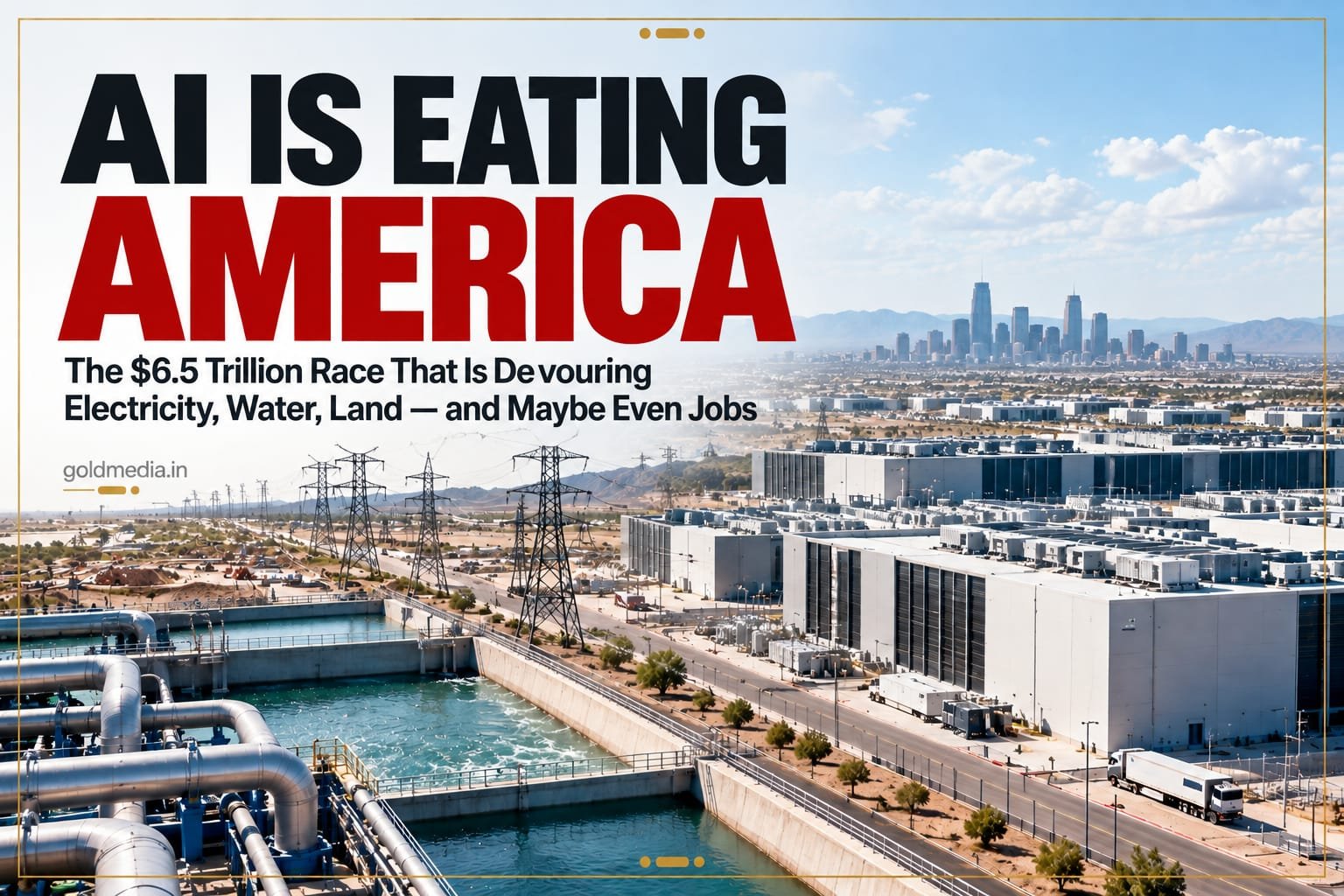
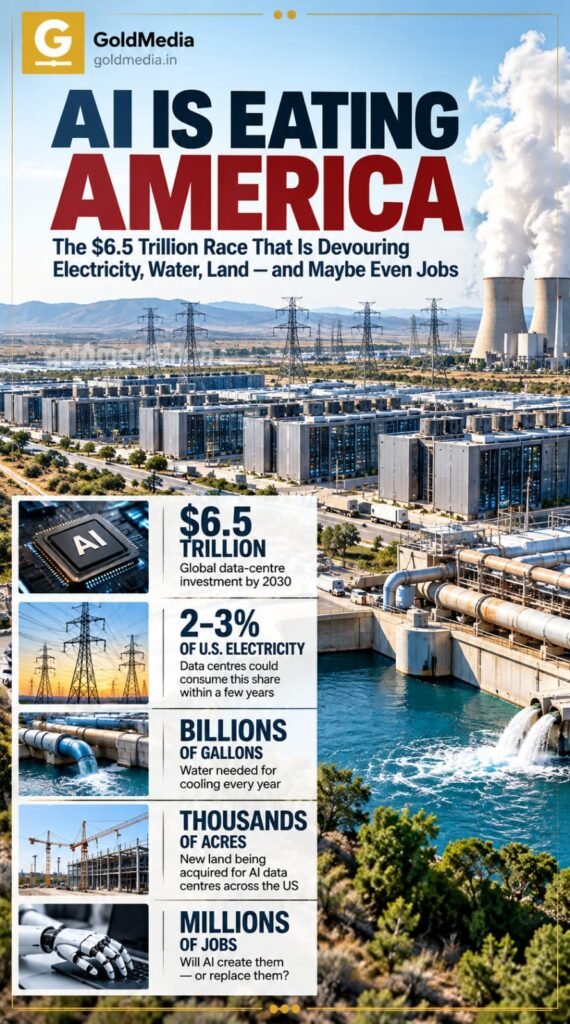
The $6.5 Trillion Race That Is Devouring Electricity, Water, Land—and Maybe Even Jobs
You thought AI lived in your phone. It doesn’t.
You ask ChatGPT a question.
You generate an image.
You watch an AI-generated video.
You ask AI to write an email, analyse a document or translate a language.
It feels almost weightless.
But behind that innocent-looking screen is an industrial machine getting bigger by the day.
Huge data centres.
Millions of specialised chips.
Power plants.
Transmission lines.
Cooling systems.
Land.
Water.
And billions—soon potentially trillions—of dollars.
The world has entered an AI arms race.
And America is at its centre.
WELCOME TO THE AI LAND GRAB
The next great American infrastructure boom may not be highways, airports or shopping malls.
It could be data centres.
The Financial Times has reported projections that global data-centre investment could reach around $6.5 trillion by 2030, driven heavily by the explosion in AI computing demand.
That number is difficult to comprehend.
So forget the number for a moment.
Think about what $6.5 trillion requires.
It requires buildings.
It requires electricity.
It requires transformers and transmission networks.
It requires semiconductors.
It requires cooling.
It requires land.
And it requires an enormous amount of money.
AI may be digital. Its infrastructure is brutally physical.
THE CLOUD ISN’T REALLY A CLOUD
We call it “the cloud.”
But there is no cloud.
There are buildings.
And increasingly, those buildings look more like factories.
Inside them sit thousands of servers operating around the clock.
AI models require enormous computing power during training and when millions of people use them simultaneously.
The consequence is simple:
More AI = More computing = More electricity.
And America is now scrambling to make sure it has enough electricity to feed the machines.

THE NEW GOLD RUSH: ELECTRICITY
For decades, America’s electricity demand was relatively predictable.
Now AI is changing the equation.
Technology companies are signing enormous power deals.
Utilities are planning new generation.
Natural-gas companies see an opportunity.
Nuclear power is suddenly back in the conversation.
Renewable-energy developers are chasing hyperscale data-centre customers.
And politicians are being forced to answer a rather uncomfortable question:
Who gets the electricity when there isn’t enough to go around?
A household?
A factory?
A hospital?
Or a giant data centre willing to sign a multibillion-dollar contract?
THEN COMES WATER
Electricity isn’t the only resource AI needs.
Data centres generate tremendous amounts of heat.
That heat has to go somewhere.
Depending on the cooling technology and location, water can become part of the equation.
And this creates an increasingly uncomfortable contradiction.
America wants to build the world’s most powerful AI infrastructure.
But some of the places attracting data centres are already dealing with water stress.
That creates a collision between:
AI ambition
and
local resources.
40,000 ACRES FOR AI?
One of the most extraordinary examples of this new race is emerging in Utah.
A proposed AI/data-centre development backed by investor Kevin O’Leary has involved plans covering roughly 40,000 acres, alongside massive power-generation ambitions.
The project has attracted opposition and legal and environmental scrutiny, including concerns around water, energy and the scale of the development.
That is what makes this story bigger than another technology story.
Because this isn’t merely about software anymore.
AI is beginning to reshape geography.
Where should the data centre be?
Where will the electricity come from?
Who owns the land?
Where will the water come from?
Who pays for the infrastructure?
And what happens to the surrounding communities?
THE STRANGE PARADOX
America spent decades becoming a service economy.
Now the world’s most advanced digital companies are creating a new industrial economy.
But instead of steel mills, we get server halls.
Instead of smokestacks, we get cooling systems.
Instead of factories producing cars, we get facilities producing something invisible:
COMPUTE.
And compute is becoming one of the world’s most valuable resources.
AND THEN THERE’S NVIDIA
At the heart of this revolution sits another extraordinary story.
The AI boom has created enormous demand for Nvidia’s specialised processors.
The company that was once primarily known to gamers has become one of the central suppliers of the infrastructure powering the AI revolution.
The logic is circular:
More AI applications
↓
More computing demand
↓
More chips
↓
More data centres
↓
More electricity
↓
More infrastructure
↓
More investment
↓
More AI applications
The machine keeps feeding itself.
BUT WHAT ABOUT JOBS?
This is where the story becomes personal.
The AI boom is creating jobs.
Data-centre construction needs engineers, electricians, technicians and construction workers.
Chip manufacturing requires highly skilled workers.
AI companies are hiring researchers and engineers.
But simultaneously, companies across the economy are experimenting with AI to reduce the amount of human labour required.
Customer service.
Coding.
Marketing.
Accounting.
Translation.
Content creation.
Research.
Administration.
The question isn’t whether AI will create jobs.
It almost certainly will.
The much harder question is:
Will the jobs it creates replace the jobs it destroys—or simply create a completely different economy?
Nobody has a definitive answer yet.
THE BILL WILL EVENTUALLY ARRIVE
There is another part of the AI boom that gets remarkably little attention.
Someone has to pay for all this infrastructure.
AI companies can invest billions.
Technology investors can finance data centres.
Utilities can build new generation.
Governments can provide infrastructure and incentives.
But ultimately, infrastructure has a cost.
And that cost can travel through:
electricity prices
taxes
utility investments
land prices
corporate spending
consumer prices
and potentially higher returns demanded by investors.
The AI revolution may therefore become something much bigger than a technology story.
It could become an economic story affecting everyone.
AND INDIA IS NOT OUTSIDE THIS STORY
India is simultaneously becoming one of the world’s biggest digital economies and a major destination for data-centre investment.
That creates an enormous opportunity.
But it creates the same questions:
Where does the electricity come from?
How much land should be devoted to data centres?
How much water should they consume?
Who pays for transmission infrastructure?
How many high-quality jobs do they create?
And perhaps the biggest question:
Does India want to merely consume AI—or become one of the countries building its infrastructure?
THE NEXT BATTLE MAY NOT BE FOR CHIPS
For years, everyone talked about the semiconductor race.
America versus China.
Nvidia versus its competitors.
TSMC.
Advanced chips.
AI models.
But the next bottleneck may be much more ordinary.
POWER.
You cannot run a trillion-dollar AI economy without electricity.
You cannot build unlimited data centres without land.
And you cannot cool everything everywhere without dealing with physical resources.
The technology may be futuristic.
The constraints are ancient.
Energy. Water. Land.
THE BIGGEST IRONY OF AI
AI was supposed to make the world more efficient.
And in many ways, it will.
But building the physical infrastructure required to run increasingly powerful AI systems could create an enormous new demand for resources.
That’s the paradox:
The more “virtual” our world becomes, the more physical infrastructure it may require.
Your AI assistant may be sitting on your phone.
But somewhere far away, a giant machine is working to answer you.
And thousands of other people are asking it questions too.
SO, IS AI REALLY “EATING AMERICA”?
Not literally.
But the phrase captures something important.
AI is increasingly competing for the same things every other part of the economy needs:
Electricity.
Water.
Land.
Capital.
Workers.
Infrastructure.
And America is betting enormous amounts of money that the payoff will justify the cost.
Perhaps it will.
Perhaps the technology will unlock an extraordinary wave of productivity.
But the experiment is already underway.
The world’s biggest technology revolution is becoming America’s biggest infrastructure experiment.
And the next time you type:
“Ask ChatGPT…”
remember:
Somewhere, something has to power the answer.
AI isn’t floating in the cloud.
It is consuming the real world.
GOLDMEDIA
THE AI REVOLUTION HAS LEFT THE SCREEN.
NOW IT’S COMING FOR THE POWER GRID.